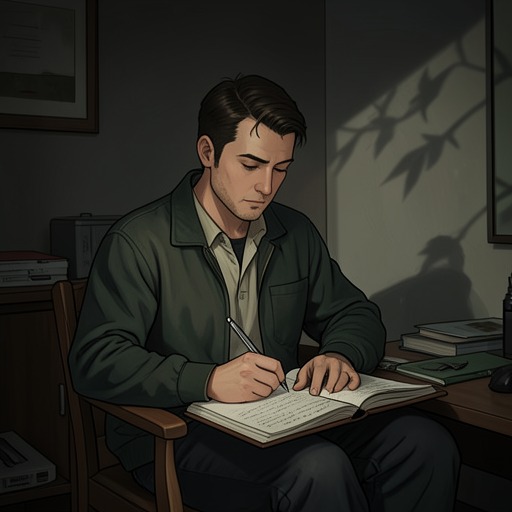
Fiction, Narrative, and Truth
Straight ManFiction, narrative, and truth are inseparable in William Henry Devereaux, Jr.’s thinking, but they are not interchangeable: a story can make experience legible without proving that its account is the whole truth. As he confronts secrets, uncertain motives, and his own long creative dormancy, he tests how far invention and inference can take him—and repeatedly finds that facts do not, by themselves, explain people.
Secrecy and the Limits of Disclosure
When Russell asks about William Henry Devereaux, Jr.’s disappearance into the ceiling above his office, Devereaux offers a comic explanation involving falling asleep and wetting his pants. He then declines to give Russell the real account, reasoning that he can invent something more plausible later. The evasion matters partly because Devereaux once had a reputation as a writer of realistic fiction: The New York Times had praised the young novelist’s stories as having “taken firm root in the garden of realistic fictions.” Yet a capacity for convincing invention does not guarantee a willingness—or an ability—to tell the truth about himself.
Russell is hurt because he believes he has told Devereaux everything. Devereaux answers, “We never tell everything.” Russell appears surprised that Devereaux recognizes the principle, as though concealment were his own private discovery. The exchange makes secrecy a shared human condition rather than merely a single character’s deception. Devereaux’s professional identity as a storyteller sharpens the irony: he can recognize the gaps in another person’s account while choosing to leave gaps in his own.
Inference, Facts, and Motive
Devereaux’s reasoning about Tony Coniglia’s recent difficulties offers a practical example of how a narrative can be built from circumstantial clues. He connects the girl he saw in a police car with the woman who had appeared near Tony’s house, recalls her insistence that he ask Tony what happened there, and links her presence on campus to the cancellation of his racquetball match with Tony. The explanation accounts for the main facts without contradicting them, and Devereaux compares its economy to Occam’s razor.
But he distinguishes a plausible factual outline from an understanding of what the events mean. Even if his deduction is right, it cannot supply the woman’s motives or disclose the human truth behind the sequence. He contrasts this limitation with the breakup of Russell and Julie Devereaux’s marriage: an observer armed with a tidy list of physical details could not thereby understand the failure of their love. Rational economy may help explain physical circumstances, but emotional life resists the same simplification. Devereaux’s former novelist’s instinct is to ask how close he might get to deeper truths by proceeding from the facts; his answer is that the distance remains considerable.
The distinction also unsettles the authority of intuition. Tony’s mock investigation of vomit on Devereaux’s car shows how easily a set of observations can be made to sound like an explanation without reaching genuine understanding. A narrative can connect details coherently and still miss the reasons that matter. Devereaux therefore treats inference not as access to certainty but as a provisional arrangement: a way of making events intelligible whose limits become visible when the subject is a person.
Invention and the Self-Conscious Narrator
While Tony talks over coffee in an otherwise empty restaurant, Devereaux composes an account of Yolanda Ackles’s experience after skipping medication. In that imagined passage, her elation becomes a sailing scene: the wind fills her sails, other revelers wave, and the sky seems to open into blue. The metaphor gives a shape to her exhilaration and to the danger of its reversal, when the winds might drive her toward Hereford Clinic and medication’s calm might return her to isolation. But Devereaux explicitly identifies the sailing metaphor and omniscient narration as his own inventions, not as knowledge he has acquired from Yolanda.
That distinction makes the scene self-conscious about the powers and risks of fiction. Devereaux has spent recent years limiting his creative work largely to opinion writing for Railton Rear View, though he continues to teach omniscient narration to fiction writers. Now he turns to the technique himself, drawn to it in middle age because his wife and daughter say he recognizes truths late and then prefers to appear as though he knew them all along. Omniscience promises a way to tell what he cannot grasp from the more modest position of a first-person observer. It also exposes the temptation to convert incomplete knowledge into a confident account.
Story, Causality, and Teaching
In a writing workshop, Devereaux confronts the gap between a made-up story and the real events competing for his students’ attention. He asks them to discuss Solange’s story, “The Clouds of August,” whose protagonist repeatedly stops to contemplate increasingly ominous clouds. A student calls the clouds a metaphor, but Devereaux presses beyond interpretation to ask what literally happens. His request for a plot summary—one event causing another in a sequence—reveals that the story may have no discernible chain of action at all.
Asked to explain it herself, Solange says that the protagonist falls in love and then falls out of love, as happens in real life. Her answer gives the story a simple event structure that the class had not recognized. The episode exposes a tension at the heart of Devereaux’s teaching: actual events can seem more compelling than an unsuccessful fiction, yet the writer’s task is to make invented stories compelling through the shaping of events. Plot is not merely a label for whatever happens; it is a way of making relationships among events available to a reader.
Consequence and the Meaning of a Life
Devereaux’s conversation with his father, William Henry Devereaux, Sr., offers another example of how a life can be arranged into a story. His father begins recounting the loss of his voice when he went to Columbia University, presenting the episode as a crisis of the soul that might console his son. The account wanders through his exceptional salary and eventually returns to his triumphal Dickens lecture. Its apparent subject shifts from vulnerability to professional vindication. When his father admits that he has begun rereading Dickens and feels he may have sinned against the writer, Devereaux recognizes that the conversation is really one his father is having with himself. The story’s meaning changes as the teller’s emphasis changes.
The same uncertainty governs Devereaux’s reflections on cause and consequence. He considers how people cannot know in advance whom they will betray or what they will do in a particular circumstance. His mother’s attempt to save him in a childhood crisis, he argues, set in motion a mutual estrangement because the shared anguish could not simply be forgotten. An action may therefore begin severing itself from clear significance even for the person who performs it. Only afterward does its place in a life become narratable, and even then the account may not settle what it meant.
Against that uncertainty, Devereaux describes the need for spouses, children, parents, colleagues, and friends who can recognize a person more clearly than that person recognizes himself. They may have to say, “I know you, Al. You’re not the kind of man who.” Such recognition does not eliminate the possibility of surprise or guarantee that any single account is complete. Instead, it shows why truth in the novel is relational: stories are revised through other people’s knowledge, while the space between an event and its meaning remains open.